A Worthy Curse
by Marcelle J.J. Padilla
written February 5, 2026
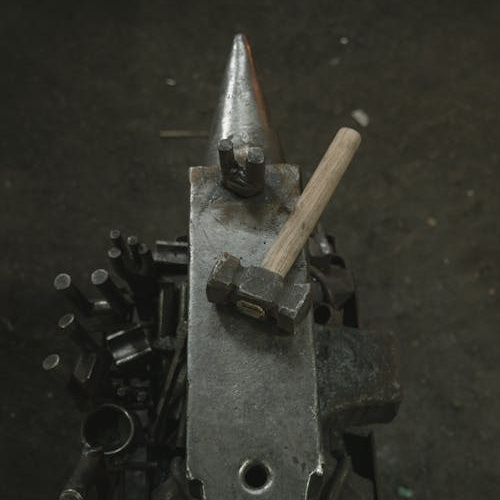
As the trumpets start their fanfare off in the distance, I set my drawplate down on the workbench, overwhelmed with the frustration that they will take so long to arrive and expose me.
Voices flood my mind and then fade as a crowd heads off toward the prince’s entourage. Light hurts my eyes. It’s coming from the drawplate, reflecting the forge’s fire. I could refuse to pick it up, leave the iron as an unshaped bar, and have no freshly-forged corkscrew to present to the prince when he stops by to inspect it. That would be a surefire way to eliminate the false reputation hanging over me.
But when I turn my eyes away from the light, there’s Vanderman standing right by my workstand, newly arrived, his blacksmith crest also reflecting the fire and his voice booming alongside the trumpets. Before I know it, I pick up the drawplate again. Vanderman comes to wish me good luck, assuring me that the prince has chosen only the finest, and that I shall go home to a proud father. Though he’s in a hurry, he stays long enough to have inspected my way of working—and yet he doesn’t make a single remark about the misshapen and overly-thin iron bar, nor about the sheer ineptitude of my hands adjusting the plate. Hands that are far from deserving the crest we both share.
Though I smile at him as he leaves and joins the crowd, under my breath I utter my loathing toward the curse. Vanderman’s false kindness, the walls of the workstand that present my upper body for all onlookers to see but that conveniently hide my hands and tools, and the very fact that I’ve progressed to such an important job—all of it is the curse’s doing. All of this convenience and irony is part of the ceaseless torture that has gone on for so long I can’t even remember how and when it all began.
The trumpets are like a constant ringing in my head, one that is slowly approaching. This must be a new component of the curse, hanging over me like a sword tied to a thread in the sky. Whenever people passing by stop and give me their ignorant praises, I can feel their eyes trailing upward at that hanging sword, and their voices holding back their laughter as they envision the moment it finally drops on my head. With my hands heating up as I hold the iron rod over the fire, it takes all of my willpower not to strike down these sniveling onlookers. As the softening of the metal becomes yet another slow process to prolong my torture, I look up at the unseen sword. Why can’t it drop right now and end this all? The curse is merciless.
The walls are both my ally and my adversary. They are my gateway to a realm I’m all too familiar with: the one where I am like the king of a rapidly crumbling castle, free to do as I please, but struggling to collect myself as best I can before everything falls away and leaves me vulnerable to the scrutiny of others. This realm is another construct of the curse, and so is the compulsion to collect myself in a frantic panic. The slipshod hammering that I’m exacting on this iron bar is driven by that compulsion, by the curse made flesh in my hands that seeks to trap me in this realm of suffering over and over again.
My ears are ringing from the trumpets and the uneven rhythm of my hammering by the time the entourage arrives at my stand. When their bodies turn and their footsteps fall in impossible synchronity, their eyes all pierce into my own, making something deep within me want to lurch out of my flesh.
Bring the iron bar up, higher, right on top of the wall where they can see its deformity.
Swing the hammer down, over and over, so that they can bear witness to the lack of rhythm, the lack of precision, the lack of any skill.
Let him rip off this godforsaken veil.
I show them all of it. All of it, on top of the workstand, right where the crowd and royal guard can see. But the curse manipulates the situation yet again, as everyone’s attention is instead drawn to the trumpets, who have all gone silent except for two leads who have raised their instruments and pitches skyward. The guards’ formation splits down the middle, and from that gap emerges the prince. In his hand, he holds the coming-of-age gift from his godmother: a bottled ship, an enchanted one that will expand to a full-fledged vessel in the royal harbour once the bottle’s cork is removed—using the corkscrew that I am forging.
His inspection commences quickly. I don’t have the chance to prepare or think of preparing, but the start of these judgements isn’t what worries me. It’s the silence and stillness afterwards, that lull in time where I’m awaiting the words that will decide my fate. I’m akin to a heretic standing trial in a reversed world, praying to be pronounced “Guilty” so that I can finally be set free.
And yet, even though that is my wish, I’m suddenly overwhelmed by the cavalcade of armours and colourful garments, the legion of eyes staring out at the two of us, the ocean of hushed voices that had drowned the silence only moments ago. All here, right in front me. If the prince were to grant my wish now, spoken in that titanic voice that pierces the air and commands everyone’s attention, I know that I would crumble. My spirit would be free, free from the curse, but the eyes and ears bearing witness would execute my will to live with their scorn.
I loathe this silent wait, yet I can’t bear for it to end.
As the prince stares down at the farce on top of my workstand, his smile doesn’t falter. He’s someone who has perfected his smile like a wizard’s spell, along with the proud shoulders and broad chest that emphasize the extravagant embroidery on his tunic. It is natural, effortless. He is the zenith of adhering to the order of the world, one who would never tolerate something so clearly out-of-line.
And right in front of him, I tremble, knowing what’s soon to come: the moment that smile falters. When it does, freedom and scorn will follow. I hope they are to follow.
But the prince surprises me by raising his head early. His smile is still unbroken. He speaks, directing his gestures toward me but amplifying his voice for the many:
“Well met, dear blacksmith. This tool is coming along perfectly. Once you are finished, join the procession. I shall await the fruit of your labour down at the harbour.”
His words carry finality, yet he remains standing in the same spot, his smile still present but strained. This is because I’ve failed to hide the disblief and anger on my face.
And who wouldn’t, in this situation? How could the curse’s influence have extended this far? If the royal family isn’t exempt, will the Gods themselves descend from the heavens and join in? But what could I have possibly done to deserve this punishment, to have myself displaced from everyone and everything I know just so I can serve as a laughing stock? I clench my hands into fists, wondering if the twitch in the prince’s smile could be from barely-restrained laughter.
But his figure is strong, their eyes are many, and my spirit is weak. A single blow is all it would take to crumble me.
I relax my hands, but fail to do the same for my face before my vision grows clouded with tears. As I wipe them, I can’t make out what the crowd are saying or doing, but I can see the prince’s eyes grow wide with concern. I know his reaction is false, that it’s yet another component of the curse, yet still I say to him: “My apologies, Your Highness. I will never be worthy of crafting and delivering such a crucial item to you.”
The prince steps closer to me, his smile returning, and I brace myself. Whether it’s imminent laughter or more false words of assurance, either one would be fit for the killing blow at my lowest point. But as he draws closer, I see that the skin around his eyes carries creases—of regret, grief, or worry, I’m not certain—that have been weathered in like cracks in an old stone. In a low voice that the crowd is unlikely to hear, he says:
“I am the one who will never be worthy. Of your craft, of my godmother’s gift, of anything you see here today.”
As soon as he finishes speaking, he steps back, resuming his proud posture, but not before stumbling slightly in his haste. Regardless, he turns to the crowd, saying:
“What a talented, humble young man! Join me in preparing to sing his praises down at the harbour. Hurrah!”
The crowd hurrahs in response, then the royal guard’s formation parts, rejoins, and the entourage starts off for their destination once more.
I’m left at my workstand, alone and frustrated. Why could he not have said more? His words, his voice, the creases around his eyes—none of it appeared to have been an illusion. And yet, with only a mere two sentences to go off of, how can I convince myself that this wasn’t a bout of acting brought on by the curse?
I raise my hammer and drop it down on the hideous iron bar with a heavy swing, feeling my strength and focus return. I will never be certain of it, but if the prince has also been afflicted with the curse, he will need that corkscrew and many more tools to help him scrape by.